How Production Studios, Publishers, and License Holders Affect the Korean Availability of Anime and Manga
When searching for a favorite anime series or manga title on popular South Korean platforms such as Laftel, Aniplus, Kakao Webtoon, or Naver Series, viewers are often surprised to find the content completely absent. Even if a series is creating massive hype worldwide, its official release in the South Korean market follows complex legal and commercial rules. The availability of any given work depends on three distinct entities: the Production Studio / Production Committee, the original Manga Publisher, and the Distribution License Holder. Each party holds the authority to decide, delay, or block the release of a title in South Korea.
The IP Supply Chain: Who Really Controls Anime and Manga Releases in South Korea?
To understand why an anime or manga is available in South Korea, it is essential to analyze the role of each link in the Intellectual Property (IP) ownership chain.
Japanese Production Committees (Seisakusaiinkai) & Animation Studios
Most Japanese television anime are funded and owned by a Production Committee (Seisakusaiinkai) consisting of multiple stakeholders: publishers, music record labels, TV networks, toy manufacturers, and animation studios (such as MAPPA, Wit Studio, or Toei Animation). This committee holds the complete commercial copyright and determines international licensing strategies.
Animation studios are primarily content creators and contractors. The rights to negotiate and sell broadcasting licenses reside with the Production Committee. If the committee decides not to sell licensing rights for the South Korean region, or demands excessive exclusivity fees that exceed the financial capacity of Korean broadcasters, the anime cannot be legally distributed in South Korea.
Original Manga/Light Novel Publishers (Shueisha, Kodansha, Kadokawa)
For manga and light novels, major Japanese publishing conglomerates like Shueisha, Kodansha, Shogakukan, and Kadokawa hold the rights to the original work. They decide whether to grant digital distribution rights and physical printing rights to international partners.
Japanese publishers enforce strict licensing policies. They may grant physical printing rights to a Korean publisher while withholding digital distribution rights, or sign an exclusive digital agreement with only a single online webtoon platform.
Master License Holders and Local Korean Distributors
Regional license holders (such as Muse Communication, Ani-One, Crunchyroll, or Netflix) acquire distribution rights from Japan for specific geographical zones. Subsequently, they sub-license these rights to local cable networks or OTT platforms in South Korea.
In South Korea, local distribution companies serve as the direct bridge:
- Anime Sector: Aniplus, Animax Korea, and Daewon Media purchase broadcasting rights, manage translation and subtitling/dubbing, and supply content to streaming apps like Laftel, Watcha, and Wavve.
- Manga Sector: Domestic publishing houses such as Daewon C.I., Haksan Publishing, and Seoul Cultural Publishers negotiate rights for translation and physical/digital printing.
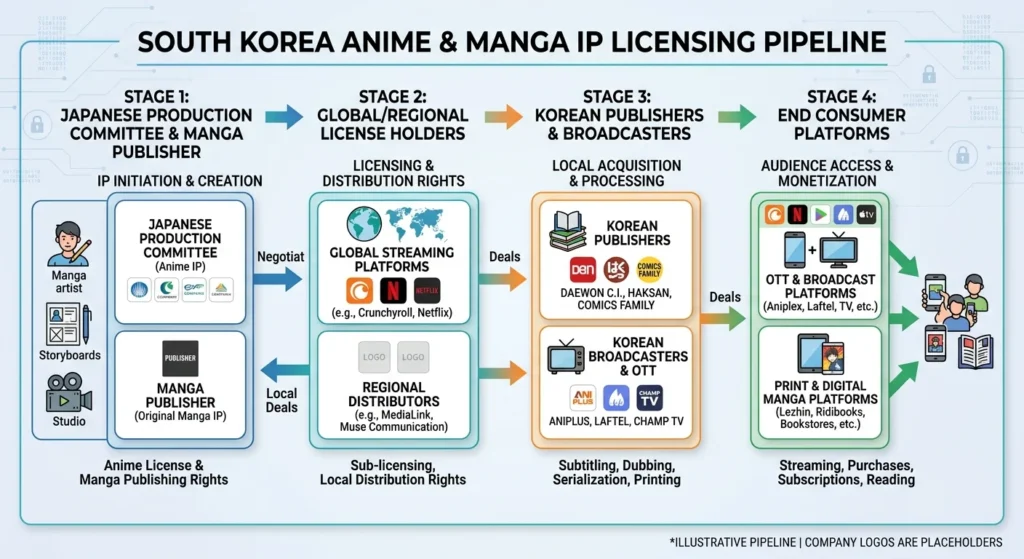
Licensing Chain Matrix: From Original Creation to South Korean Screens
The table below outlines the distribution process from the Japanese IP owners down to the South Korean consumer market:
| Supply Chain Tier | Representative Entity | Decisive Role in the South Korean Market |
|---|---|---|
| Original IP Owners | Production Committee / Japanese Publishers (Shueisha, Kadokawa) | Structure regional licensing bundles and establish minimum floor fees |
| Regional License Holders | Muse Communication, Ani-One, Crunchyroll | Acquire East Asian licensing packages and negotiate local sub-licensing |
| South Korean Importers | Aniplus, Daewon Media, Haksan, Seoul Culture | Cover costs for translation, editing, and submission for age rating censorship |
| End Distribution Platforms | Laftel, Kakao Webtoon, Naver Series, Netflix Korea | Deliver content to end consumers via subscription packages or pay-per-view |
Main Barriers Delaying or Blocking Anime/Manga Releases in South Korea
The absence of an anime title or manga chapter on Korean applications typically stems from three major commercial and regulatory hurdles.
Regional Bundling & Bidding Competition
Japanese production committees frequently bundle anime licensing rights by region (e.g., East Asia bundles encompassing South Korea, Taiwan, and Hong Kong). If a global streaming platform acquires exclusive global rights but fails to establish Korean localization or regional server infrastructure, viewers in South Korea end up geo-blocked.
Fierce bidding wars between Korean importers (such as Aniplus competing against Daewon Media) can also prolong negotiations, causing anime releases to lag several months behind their Japanese broadcast dates.
Age Classification and Content Censorship (KMRB / KCSC)
South Korea enforces rigorous content rating regulations on imported entertainment products. Before commercial release, all anime and manga titles must pass through regulatory bodies:
- KMRB (Korea Media Rating Board): Evaluates content and assigns official age ratings (ALL, 12+, 15+, 19+).
- KCSC (Korea Communications Standards Commission): Monitors violent, explicit, or politically sensitive themes.
Anime featuring graphic violence or sensitive themes often requires frame editing, blurring, or restricted 19+ ratings (requiring real-name identity verification on mobile apps). This evaluation process can delay release dates by several weeks to months.
Separate Contracts for Digital (E-Book) and Physical Rights
Publishing rights are strictly segregated between physical print books and digital file distribution. A South Korean publisher might hold the print publication rights for a manga series signed ten years ago, but that contract does not automatically grant digital rights for platforms like Naver Series or Kakao Webtoon. To release the series online, the publisher and Japanese licensor must negotiate a brand-new digital license contract.
4-Step Process for Checking Anime/Manga Licensing Status in South Korea
To verify whether a title has been officially licensed in South Korea, follow this 4-step verification procedure.
Search Specialized Local Platforms (Laftel / Naver Series)
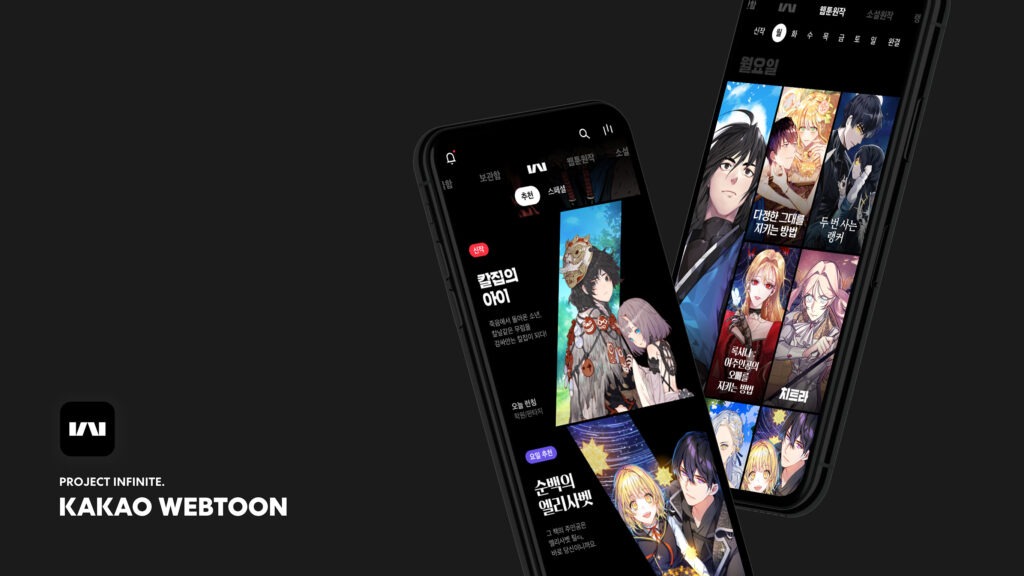
Laftel is the largest dedicated anime streaming service in South Korea, while Naver Series and Kakao Webtoon hold dominant shares in digital manga. Input the original Japanese title or English name into the search bar. If the platform displays a “Licensing Requested” status tag, the licensing agreement has not yet been finalized.
Review Cable Network Broadcast Schedules (Aniplus / Animax Korea)
For seasonal anime broadcasts, check the official websites of Aniplus or Animax Korea. These two cable networks hold the highest volume of simulcast licensing agreements from Japan.
Verify Official Importers (Daewon C.I. / Haksan)
Search for the title on official publisher portals operated by Daewon C.I., Haksan Publishing, or Seoul Cultural Publishers to confirm whether an official Korean translation has been licensed.
Track Censorship Approval Status via KMRB
Access the public database of the Korea Media Rating Board (kmrb.or.kr) and query the title name. If the censorship log lists the rating as “Classification Completed,” the title is scheduled to debut on commercial streaming platforms shortly.
FAQ
Why is an anime available on US/Japan Netflix but missing from Netflix Korea?
Netflix content catalogs are partitioned by region through independent licensing deals. If South Korean broadcast rights were sold exclusively to local entities like Aniplus or Laftel, Netflix Korea cannot stream the title despite its availability on Netflix in other territories.
Why are certain scenes blurred or cut when watching anime on South Korean apps?
This is due to age rating regulations mandated by the KMRB and KCSC broadcasting standards. To lower a show’s rating from 19+ down to 15+ for broader market reach, Korean distributors are required to censor or edit out graphic violence or explicit visuals.
How can I confirm whether a manga series has a digital e-book release in South Korea?
Check digital platforms directly, such as Naver Series, Kakao Page, or Ridibooks. If a manga appears only as a physical book at brick-and-mortar stores like Kyobo Book Centre but is absent from digital platforms, the domestic publisher has not acquired digital e-book rights from the Japanese licensor.
Is using a VPN to stream anime from foreign platforms legal in South Korea?
Most streaming platforms (including Crunchyroll and Netflix) explicitly prohibit VPNs and geo-blocking bypass tools in their Terms of Service. Doing so may result in account restriction or temporary suspension.